

Top > Applications > Relaxivity Applications
Relaxivity measurement on contrast agents is one of the most prominent applications in NMR relaxometry. Unlike protein dynamics studies — where relaxation is observed on the solute side — relaxivity measurements focus on the solvent: specifically, how the presence of a contrast agent alters the longitudinal relaxation rate (R1) of surrounding water protons. This field-dependent perturbation is expressed as relaxivity r1 (in mM-1s-1), which quantifies how efficiently an agent shortens T1; per unit concentration.
MRI contrast agents — predominantly Gd3+ chelates and iron oxide nanoparticles — accelerate water relaxation through inner-sphere coordination and outer-sphere diffusion mechanisms. The interplay between these contributions produces a characteristic field-dependent profile known as the Nuclear Magnetic Relaxation Dispersion (NMRD) profile. Measuring the full NMRD profile across a wide magnetic field range is essential to understand the relaxation mechanism, guide molecular design, and predict agent performance at clinical field strengths.
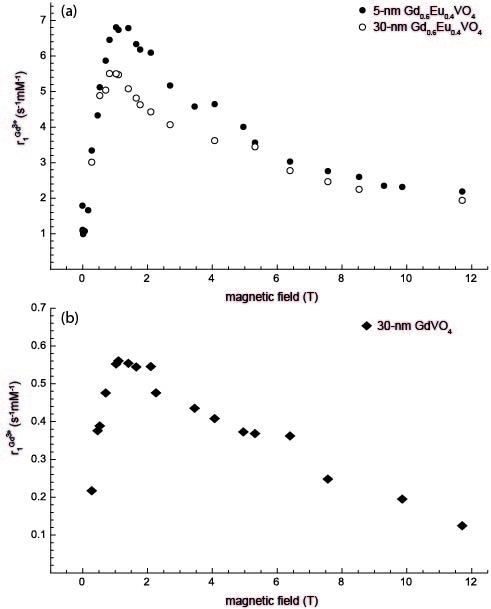
The High-Field Field-Cycler (HFFC) is well-suited for contrast agent characterization because it operates inside a high-field superconducting magnet — compatible with systems from 500 MHz up to 1.3 GHz (11.7 T to ~30 T) — while retaining the ability to sweep to low fields to capture the full NMRD dispersion curve. Conventional benchtop FFC relaxometers are typically limited to fields well below 1 T, missing the clinically relevant high-field region where diagnostic imaging takes place. The HFFC closes this gap, enabling relaxivity measurements at field strengths directly comparable to, or exceeding, current clinical MRI scanners.
In published studies utilizing our field-cycler, researchers have characterized relaxivity profiles of nanoparticle-based contrast agents, demonstrating how the NMRD profile shape — including the dispersion onset frequency and plateau relaxivity — reflects particle size effects and surface chemistry. These measurements provide the quantitative foundation for optimizing agent design for target field strengths.
Study conducted using the HFFC system:
Relaxivity measurement of contrast agents. Scientific Reports 7, Article number: 44770 (2017). doi:10.1038/srep44770
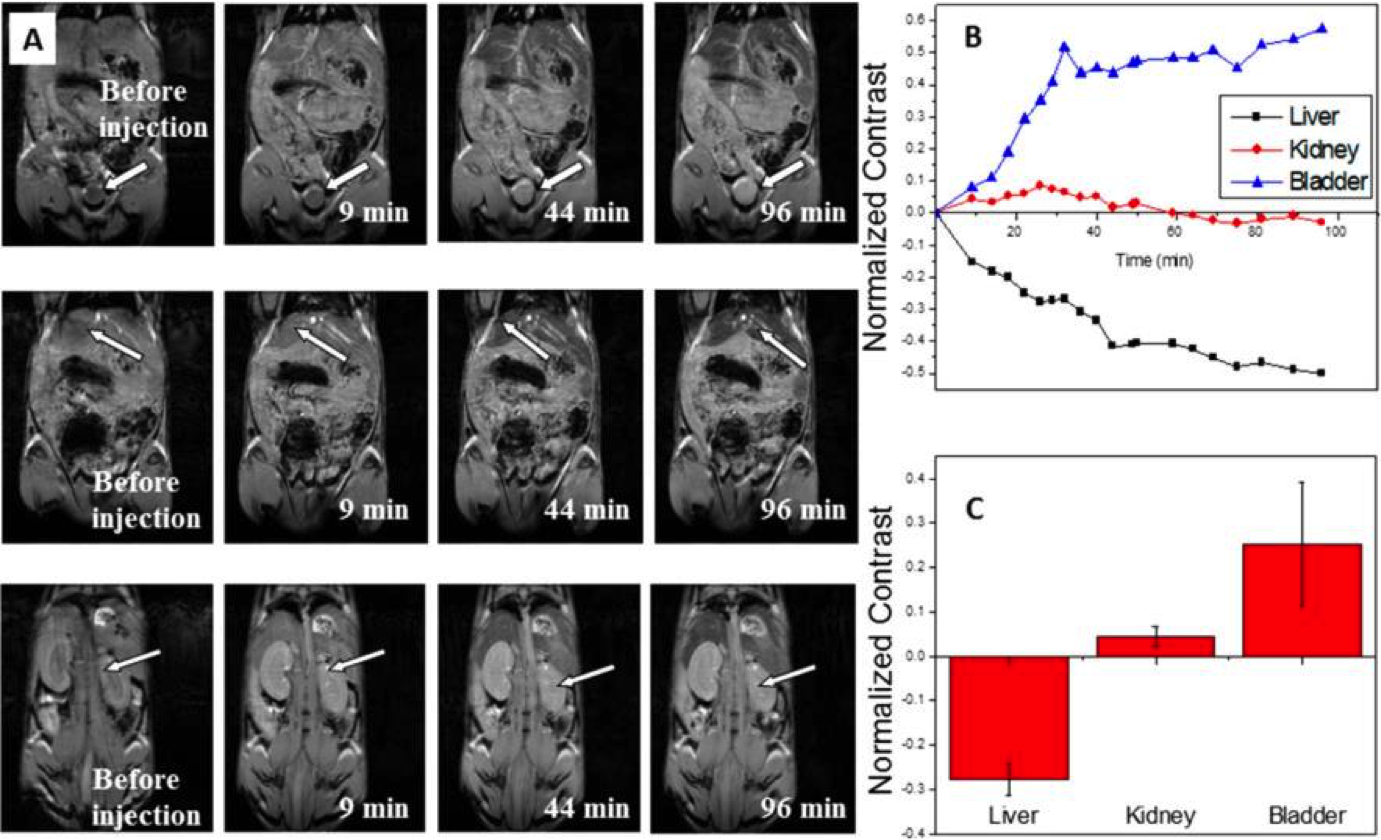
For reference on in-vivo field-cycling relaxometry methodology:
In Vivo Field-Cycling Relaxometry Using an Insert Coil for Magnetic Field Offset. Magnetic Resonance in Medicine 72(5). DOI: 10.1002/mrm.25040